Pull-Off Adhesion Testing on Heavy Steel: Interpreting ISO 4624 Failure Modes Beyond Raw MPa
A uniform surface finish and verified dry film thickness (DFT) do not guarantee interfacial bonding on fabricated structural steel. On heavy industrial projects, multilayer protective coating systems can separate entirely from the steel substrate despite presenting a visually pristine exterior. Evaluating the mechanical integrity of an anti-corrosion barrier requires hydraulic pull-off adhesion testing under ISO 4624 and ASTM D4541, where the morphology of the fracture plane provides the definitive diagnostic assessment of coating adhesion.
1. Test Selection: ASTM D3359 Cross-Cut vs. ISO 4624 Pull-Off
Selecting the correct adhesion testing protocol is directly dictated by the total dry film thickness (DFT) of the specified protective paint system. Applying an inappropriate test method generates false non-conformance records or masks underlying adhesion defects.
-
▪
Cross-Cut Tape Testing (ASTM D3359 Method B / ISO 2409): Limited strictly to thin-film coatings with a total DFT under
250 µm(recommended below 125 µm). On heavy-duty industrial systems exceeding 250 µm, multi-blade cutting tools cannot achieve a clean, perpendicular incision through to the steel substrate. Forcing the blade through thick film generates micro-cracking and sheared edges, invalidating the test. -
▪
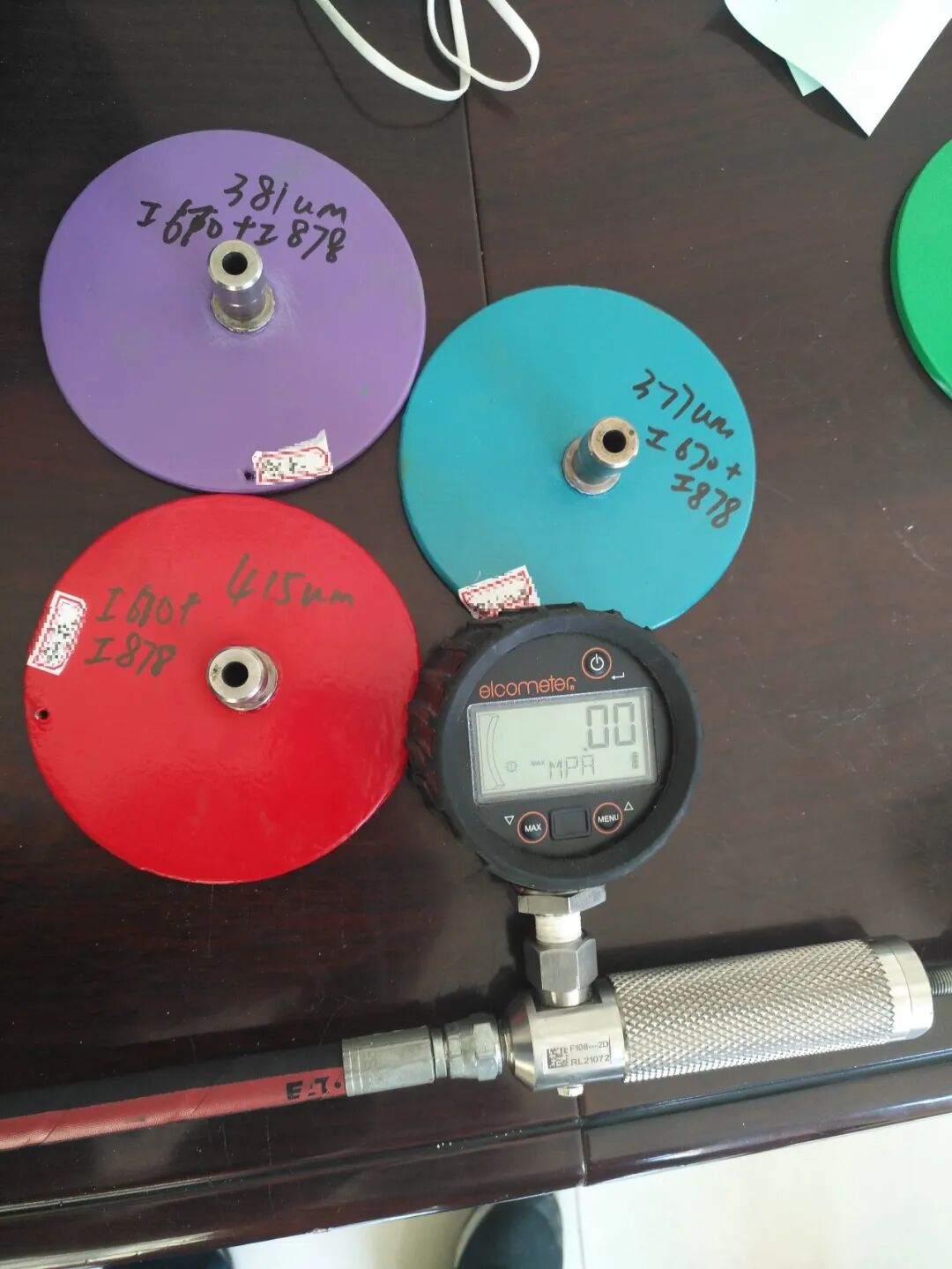
Pull-Off Adhesion Testing (ISO 4624 / ASTM D4541): The mandatory test standard for high-build C4 and C5 protective systems (typically 200 µm to 350+ µm DFT). A portable hydraulic or pneumatic tester applies a direct, perpendicular tensile load to a bonded metal dolly until a physical separation occurs.
| Parameter | Cross-Cut Test (ASTM D3359 / ISO 2409) | Pull-Off Test (ISO 4624 / ASTM D4541) |
|---|---|---|
| Applicable DFT Range | ≤ 250 µm (Optimal < 125 µm) | Unlimited (Standard for > 200 µm) |
| Stress Mechanism | Shear / Cross-hatch peel | Pure normal uniaxial tension |
| Output Metric | Visual classification (Scale 0B to 5B) | Quantitative stress (MPa or psi) + Failure Mode |
| Destructive Severity | Localized grid scoring | Localized core detachment to substrate |
| Target Application | Thin-film architectural / OEM coatings | Heavy industrial, EPC marine, and offshore steel |
2. Failure Mode Interpretation Under ISO 4624
A pull-off test report that only records a numerical tensile value (e.g., 5 MPa or 8 MPa) is structurally incomplete. The fracture plane must be visually inspected under magnification and recorded as a percentage of the total dolly surface area according to ISO 4624 guidelines.
Substrate Separation
The coating package detaches cleanly from the steel plate, exposing bare polished metal. 0% primer remains on the blast profile.
Cohesive / Intercoat
Fracture occurs inside the paint film (within primer or intermediate layer). A continuous layer of zinc primer remains tightly anchored.
Adhesive / Glue Failure
The dolly detaches cleanly from the topcoat, leaving the coating intact with adhesive residue stuck to the dolly face.
3. Environmental Execution: The Dew Point + 3°C Rule
A primary cause of Type A/B adhesive failure on industrial paint lines is disregard for microclimatic conditions during blasting and primer application.
Under ISO 12944-7 and SSPC-PA 1, abrasive blasting and paint application must cease immediately when:
When Tsteel - Tdew point < 3°C, ambient moisture condenses onto the freshly blasted steel profile, forming a microscopic water film. Spraying a hydrophobic primer (such as an epoxy zinc-rich formula) over this moisture film seals water into the profile valleys.
While the dry film thickness and initial gloss pass first-day inspection, exposure to solar radiation and field thermal cycling will volatilize the entrapped water. The resulting vapor pressure expansion drives osmotic blistering, causing catastrophic full-sheet delamination in service.
4. Field Testing Protocol: Preventing Erroneous Data
To ensure pull-off adhesion testing reflects true structural capacity rather than operator error, enforce these five site execution parameters:
Complete Adhesive Curing
High-strength two-component epoxies require a full 24-hour cure cycle at 20°C to 25°C. Testing prematurely measures the tensile softness of the glue, not the coating bond.
Surface Preparation of Dolly Interface
Lightly abrade the topcoat test spot with 400-grit paper and degrease the dolly bonding face with solvent prior to adhesive placement.
Substrate Isolation via Annular Cutter
Cut through the coating down to the steel substrate using a dedicated annular scoring tool concentric with the dolly. This eliminates lateral tensile support from surrounding paint.
Axial Perpendicular Loading
Align the reaction ring of the hydraulic actuator flat against the substrate. Eccentric or angled loading introduces peel and shear stresses, causing premature edge failure.
Representative Multi-Point Sampling
Avoid testing exclusively on flat, accessible beam webs. Distribute pull-off checks across flanges, stiffeners, and zones adjacent to weld seams where blast profile variations are most common.
Technical FAQ: Anti-Corrosion Adhesion & Standards
Q1: Why is the cross-cut adhesion test unsuitable for high-build C5 coating systems?
Cross-cut testing (ASTM D3359 / ISO 2409) requires the cutting lattice to penetrate directly to the substrate in a single pass. For heavy-duty systems exceeding 250 µm DFT (e.g., 320 µm C5 marine packages), the blade tears and fractures thick intermediate coats rather than cleanly slicing them, generating false adhesion failures. ISO 4624 pull-off testing is the standard method for these heavy systems.
Q2: What causes a Type B adhesive failure between the steel substrate and zinc-rich primer?
Type B failure indicates complete interfacial separation of the primer from the steel. This stems from inadequate abrasive blast cleaning (failing to meet Sa 2.5 / SSPC-SP 10), surface dust/oil contamination, an insufficient anchor profile (Rz < 40 µm), or painting on steel colder than the ambient dew point + 3°C.
Q3: What is the minimum acceptable pull-off adhesion strength for ISO 12944 C5 marine coating systems?
Specification requirements depend on the resin system, but ISO 12944-6 and standard marine EPC specifications typically require a minimum tensile pull-off strength of 5.0 MPa (725 psi) for epoxy-based systems over blast-cleaned steel. Values between 3.0 MPa and 5.0 MPa must be evaluated alongside the failure mode.
Q4: How does the "Dew Point + 3°C" rule prevent premature coating detachment?
Maintaining steel temperature at least 3°C above the dew point prevents invisible water condensation on the blasted steel. Applying epoxy primers over moisture blocks chemical bonding and mechanical interlock with the steel's micro-profile, leading to osmotic blistering and premature delamination under service thermal cycles.
Require Technical Coating Schedules or 3D Connection Reviews?
Our engineering division provides customized ISO 12944 paint specifications (C3 to C5-M), Sa 2.5 blast profile verification, and full NDT/TPI inspection support for global steel projects.